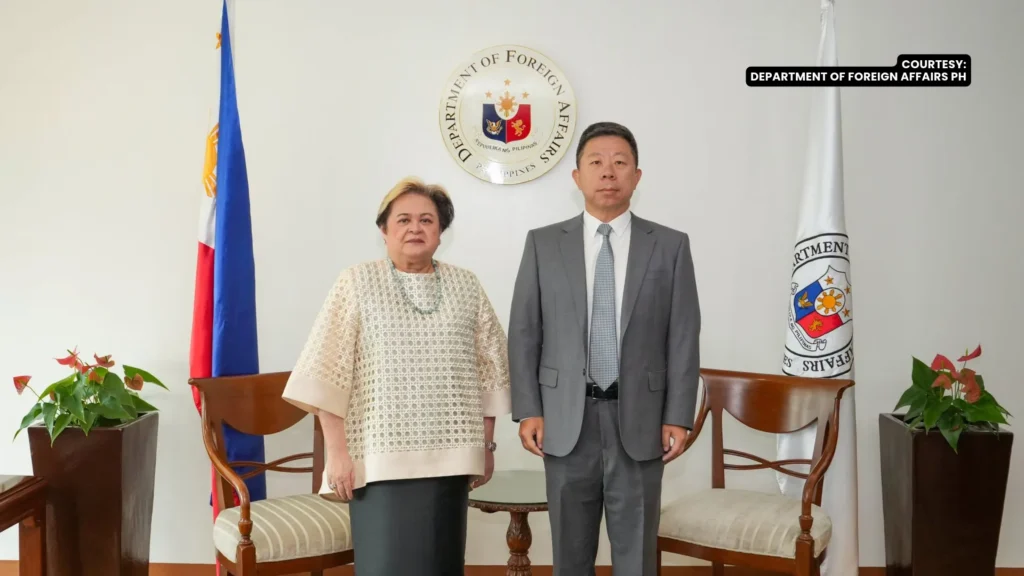
The Department of Foreign Affairs (DFA) summoned Chinese Ambassador Jing Quan on Monday to formally protest his remarks suggesting China could easily win a confrontation with the Philippines through force, amid continuing tensions between the two countries.
Foreign Affairs Secretary Ma. Theresa Lazaro conveyed the Philippines’ “serious concern and strong objection” to Jing over his public statement on October 15, the DFA said.
Lazaro described the ambassador’s remarks as “provocative and unacceptable,” saying they further strained an already sensitive bilateral relationship and undermined efforts to promote mutual understanding and cooperation.
The controversy arose after Jing told reporters in Quezon City that China could easily prevail if it chose to use force but would refrain from doing so because it valued peace.
“If we want to use force, we may easily win. But no, we will not use force. You know, we love peace, and in this region, we enjoy the peace,” Jing said.
The statement drew criticism from Philippine officials, who viewed it as an implied threat. President Ferdinand Marcos Jr. earlier said the remarks sounded threatening and were undiplomatic, adding that the matter warranted a discussion with the Chinese envoy.
Defense Secretary Gilberto Teodoro Jr. also described the statement as a threat, cautioning against taking the ambassador’s remarks at face value.
In its statement on Monday, the DFA said foreign missions should not publicly criticize or taunt Philippine officials and lawmakers who are performing their duties under their respective mandates.
“As a democracy, the Philippines values freedom of expression and a plurality of voices, and it will not accept attempts by a foreign envoy to intimidate those who exercise them,” the DFA said.
The department also emphasized that sensitive issues should be addressed through established diplomatic channels and bilateral mechanisms to preserve opportunities for dialogue.
Speaking at the Second Diliman Dialogue on October 15, Jing described Philippines-China relations as being at an “extremely sensitive and critical juncture.” He urged both countries not to allow maritime disputes to define their entire relationship, citing trade and people-to-people exchanges as areas where cooperation could continue.
The Chinese Embassy, meanwhile, pushed back against criticism of the ambassador’s remarks, accusing Philippine officials of misinterpreting his comments. In a separate social media post responding to calls by some lawmakers to declare Jing persona non grata, the embassy said: “STOP BLUFFING.”
The diplomatic dispute comes amid strained relations between Manila and Beijing over competing claims and repeated confrontations in the South China Sea, including waters within the Philippines’ exclusive economic zone that Manila calls the West Philippine Sea.
Despite the protest, the DFA said the Philippines would keep communication channels open with China and pursue cooperation in non-sensitive areas while firmly maintaining its positions on key issues.